
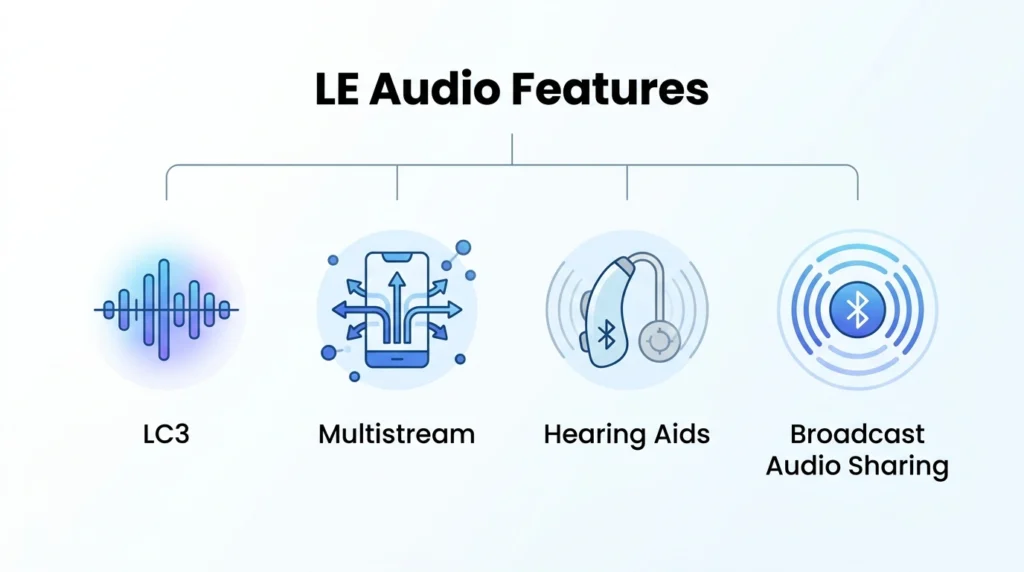
1. What is Bluetooth LE Audio? (Architecture Overview)
2. Unicast Audio in LE Audio: Server and Client Roles
3. Broadcast Audio and Auracast Technology
4. Why LE Audio Matters for IoT and Embedded Devices
1. What is Bluetooth LE Audio? (Architecture Overview)
Bluetooth LE Audio is not just a new codec; it’s a major overhaul of low-power audio transmission architecture. At the heart of this architecture are Isochronous Channels, enabling low-latency data transmission and tight synchronization.
To connect the actual audio data to these transmission channels, Bluetooth introduces a crucial intermediate layer: ISOAL (Isochronous Adaptation Layer).
The Role of ISOAL in LE Audio Architecture
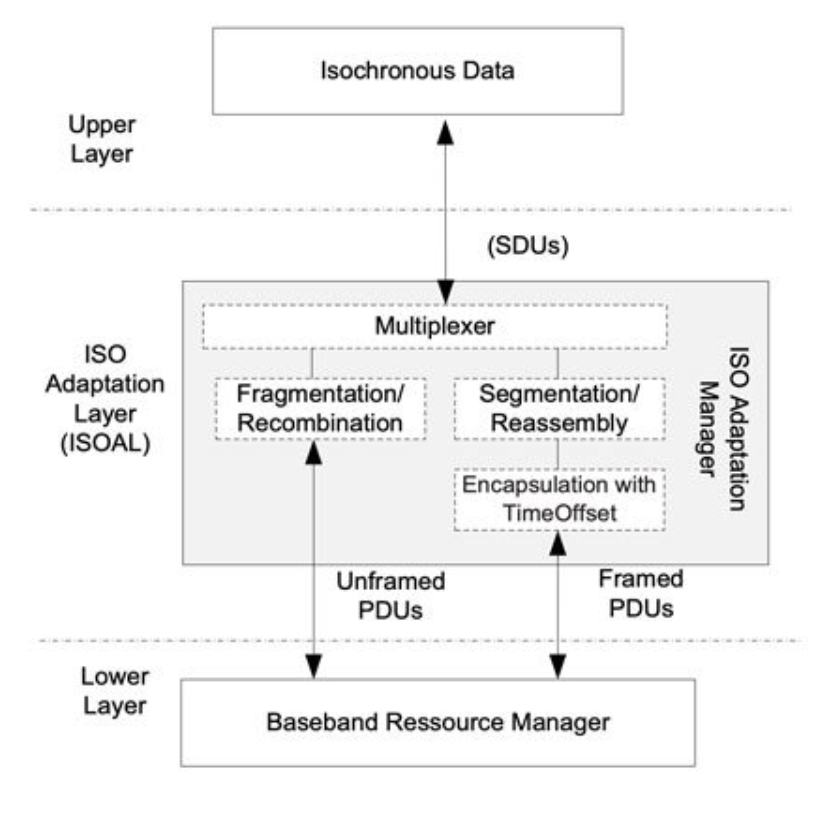
As shown in the diagram above, ISOAL acts as a data “interpreter,” situated between the application layer and the physical layer:
- Upper Layer (SDUs): This layer generates Service Data Units (SDUs) – these are encoded raw audio samples (such as from the LC3 codec). These SDUs may not perfectly match the size or duration of the radio waves.
- ISO Adaptation Layer (ISOAL): It uses two mechanisms to process the data: Unframed Mode, fragmentation of data to optimize speed. Framed Mode, segmentation and packaging with TimeOffset. This is a key factor enabling LE Audio to perfectly synchronize audio between the left and right headphones.
- Lower Layer (PDUs): After being processed by ISOAL, the data becomes Protocol Data Units (PDUs) ready for the Baseband Resource Manager to transmit over the wireless environment.
2. Unicast Audio in LE Audio: Server and Client Roles
Unicast is a point-to-point (1-to-1) data transmission method. In the diagram, the red dot represents the source (such as a phone) establishing a separate data stream directed to a single receiving device, represented by the blue dot. Although there are other devices around (yellow dots), this data is secure and dedicated solely to the chosen target.
To accomplish this, audio data from the Upper Layer passes through the ISOAL layer to be fragmented or packaged into appropriate PDUs, which are then coordinated by the Baseband Resource Manager for precise transmission to the receiving device’s address.
In the Bluetooth LE Audio architecture, Unicast connections operate based on close coordination between two roles: Unicast Client and Unicast Server. The Unicast Client is typically the source device, such as a phone or computer, actively initiating the connection and managing synchronous data streams (CIS). Here, audio data from the upper layer is fed into the ISOAL layer for encapsulation, converting service data units (SDUs) into protocol packets (PDUs) via either Unframed or Framed modes, depending on latency and synchronization requirements.
Conversely, Unicast servers are typically end devices such as headphones or hearing aids, acting as receivers and transmitters. After receiving PDU packets from the physical layer via the Baseband Resource Manager, the ISOAL layer within the server decodes and reassembly the data to restore the original audio. A key feature of this model is its point-to-point (1-to-1) transmission capability, ensuring privacy and high reliability thanks to a signal feedback mechanism between the client and server, resulting in consistently stable and accurate audio.
Interaction diagram between unicast_server and unicast_client
Based on the sequence diagram you provided, the interaction process takes place in three main phases:
- Discovery Phase: The Unicast Server (acting as an Advertiser) continuously broadcasts advertising packets (ADV_IND). The Unicast Client (acting as a Scanner) scans the frequency band to find a suitable Server.
- Connecting Phase: Upon finding a match, the Client becomes the Initiator and sends a CONNECT_REQ connection request. The Server responds with CONNECT_RSP to confirm the handshake.
- Connected Phase: After a successful connection, the two devices exchange audio data (DATA_TX/RX). At this point, the roles are clearly defined: the Client becomes the Master/Central (coordinator) and the Server becomes the Slave/Peripheral (executor)
| Feature | Unicast Client | Unicast Server |
|---|---|---|
| Core Role | Controlling device & Audio Source | Executing device & Audio Sink |
| Initial State | Scanner / Initiator: Actively scans and initiates connection requests | Advertiser: Broadcasts presence and waits to be discovered |
| Role After Connection | Master / Central: Manages connection parameters and transmission scheduling | Slave / Peripheral: Follows scheduling and responds to data requests |
| ISOAL Layer Processing | Converts audio data (SDUs) into protocol packets (PDUs) for transmission | Receives PDUs and reassembles them into original audio data (SDUs) |
| Communication Model | Targeted data transmission (1-to-1) | Receives data specifically addressed to it |
| Typical Devices | Smartphone, Laptop, Smart TV | TWS earbuds, Bluetooth speaker, Hearing aid |
3. Broadcast Audio and Auracast Technology
Broadcast Audio in Bluetooth LE Audio allows a single device to transmit audio to multiple receiving devices simultaneously without the need for individual connections as in the Unicast model. This technology is commercially available as Auracast™, opening up the possibility of public address systems where a single source can serve dozens or hundreds of surrounding devices at the same time. Instead of using Connected Isochronous Stream (CIS), Broadcast Audio uses Broadcast Isochronous Stream (BIS) organized within a Broadcast Isochronous Group (BIG). Audio is encoded using the LC3 codec and broadcast periodically via Extended Advertising and Periodic Advertising mechanisms so that receiving devices can synchronize.
Auracast Source
An Auracast Source is a device that acts as an audio broadcast transmitter. It encodes the audio signal using LC3, then creates a BIG containing one or more BISs to transmit audio data at fixed intervals. Information about the broadcast stream is published via Extended Advertising and Periodic Advertising, allowing receiving devices to detect and synchronize. In some cases, the broadcast stream can be encrypted to restrict unauthorized access. Typical devices acting as an Auracast Source include public TVs, conference audio systems, airport transmitters, or an audio gateway in an embedded system. Importantly, the Source does not need to manage each individual receiving device, making the system highly scalable.
Auracast Sink
An Auracast Sink is a device that receives and plays back broadcast audio. Instead of establishing a GATT connection like a Unicast Client, the Sink simply scans Extended Advertising to detect the source, then synchronizes with Periodic Advertising and joins BIG to receive BIS data packets. After receiving the ISO data, the device decodes LC3 and outputs the audio to a DAC or speaker. Common devices acting as Sinks include LE Audio-enabled headphones, hearing aids, LE Audio Bluetooth speakers, or embedded audio receivers. Thanks to the broadcast mechanism, multiple Sinks can listen to the same audio source with low latency and high synchronization, suitable for environments such as gyms, movie theaters, conferences, or public areas.
For a device like headphones or a hearing aid to become a true Auracast Sink, it must not simply “listen” but possess a complex protocol layer structure to decode and synchronize audio from the airwaves.
Based on a hierarchical structure, Auracast Sink operates through the following strategic layers:
- Top-level Profiles (PBP): The top layer contains the Public Broadcast Profile (PBP). This is the set of rules that define how a device identifies and receives signals from public Auracast sources.
- Audio Middleware (GAF): The Generic Audio Framework (GAF) layer acts as a general audio management framework, helping the device process concurrent data streams consistently.
- Host Functionality: Here, components such as GAP (Generic Access Profile) manage scanning and detecting surrounding broadcast devices without complex handshake procedures.
- Core (Isochronous Channels & Extended Advertising): Extended Advertising: Allows the Sink to find descriptive information about the audio stream (such as channel name, language) broadcast from the source. Isochronous Channels: These are the physical “pathways” where the actual audio data travels. With Auracast, the Sink will synchronize with the BIS (Broadcast Isochronous Streams) to receive data.
- Audio Data Path (LC3): Finally, the data stream passes through the LC3 decoder. This is the most important link in converting the digital packets received from the Core layer into high-quality, low-latency audio signals for the user’s ears.
After a detailed analysis of the Unicast and Broadcast (Auracast) models in Bluetooth LE Audio, it’s clear that each mechanism is designed for completely different system objectives. Unicast focuses on private, controlled connections optimized for individual devices, while Auracast aims for public, scalable broadcasting and multi-device synchronization. The table below summarizes the key differences between the two models at the architectural, protocol, and practical application levels.
| Criteria | Unicast Audio | Auracast (Broadcast Audio) |
|---|---|---|
| Transmission Model | 1–1 or 1–few | 1–N (scalable to many devices) |
| Connection Required | Yes (LE Connection) | No connection required |
| ISO Transport | CIS (Connected Isochronous Stream) | BIS (Broadcast Isochronous Stream) |
| Stream Grouping | No BIG | Uses BIG (Broadcast Isochronous Group) |
| Stream Control | Client configures Server | Source broadcasts publicly |
| GATT Usage | Yes (PACS, ASCS) | Not required for streaming |
| Privacy Level | High (private link) | Public (optional encryption) |
| Scalability | Limited by connection count | Highly scalable |
| Typical Use Cases | Personal earbuds, voice calls | Airports, conferences, public TVs |
| Receiver Management | Individual device management | No per-device management needed |
4. Why LE Audio Matters for IoT and Embedded Devices
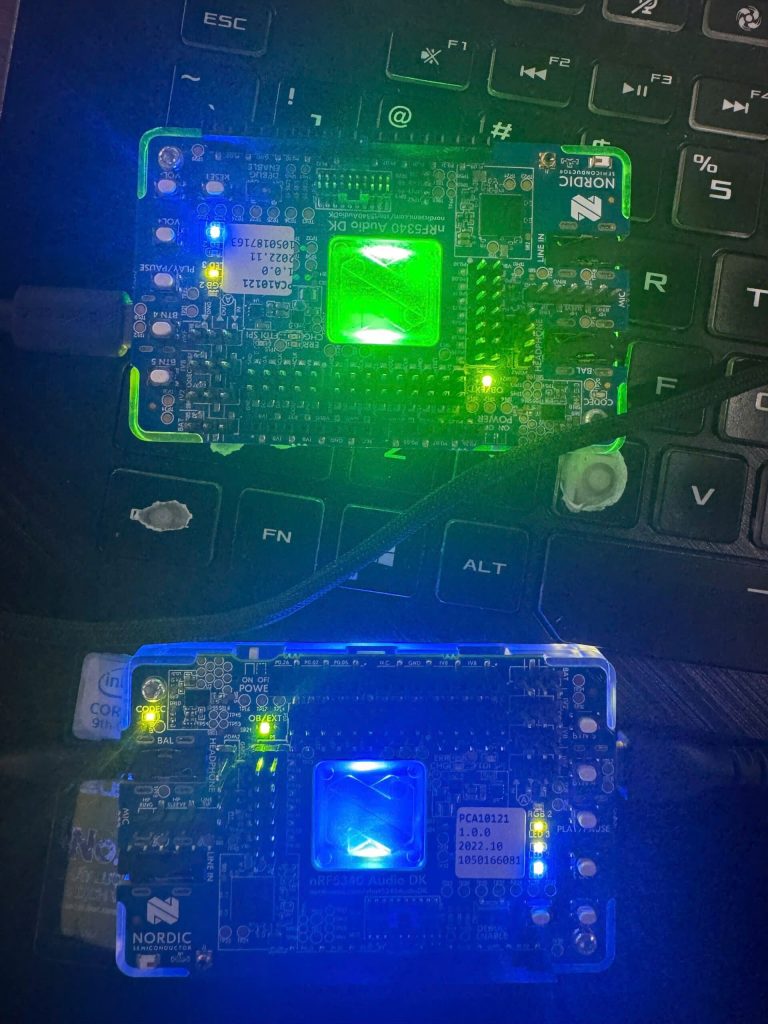
Bluetooth LE Audio not only improves sound quality but also revolutionizes how IoT and embedded systems deploy wireless audio transmission. Thanks to the LC3 codec and Isochronous Channels, LE Audio achieves better compression performance, lower latency, and lower power consumption compared to Bluetooth Classic A2DP. This is especially important for small, battery-powered devices such as true wireless earbuds, hearing aids, or industrial IoT nodes.
In the IoT field, LE Audio opens up many new application models. Multi-listener streaming allows a single device to simultaneously broadcast to multiple users while maintaining synchronization. Public broadcast systems using Auracast can be deployed in airports, shopping malls, or gyms without complex infrastructure. For low-power hearing devices, LC3 significantly reduces power consumption while maintaining high sound quality and extending battery life. In industrial environments, LE Audio can be integrated into industrial voice notification systems, where voice alerts need to be transmitted reliably, with low latency and robust operation in embedded systems.
More importantly, LE Audio is designed with a modern systems mindset: clearly separating the control layer (GATT), the stream configuration layer, and the ISO data transmission layer. This allows for a more flexible firmware architecture, easier scalability, and compatibility with RTOS platforms such as Zephyr or dedicated dual-core audio SoCs.
Conclusion
Bluetooth LE Audio is not simply an upgrade of traditional Bluetooth Audio, but a completely new architecture with two core operating models: Unicast and Auracast Broadcast. Each model serves a different system objective but can coexist within a single device platform.
In particular, Unicast Server and Unicast Client are suitable for personal audio applications such as headsets, voice calls, or hearing aids, where private connectivity and tight control are required. Conversely, Auracast Source and Auracast Sink are geared towards large-scale broadcast models, where a single source can serve multiple receiving devices simultaneously without managing each connection individually.
The flexibility between these two transmission mechanisms, combined with LC3 and Isochronous Channels, makes LE Audio a strategic platform for the next generation of embedded audio systems — from consumer devices and industrial IoT to smart public address systems.