
1.What is NB-IoT? – Overview of Narrowband IoT
2. NB-IoT Network Architecture
2.1. LTE Access Network (eNodeB & Uu Interface)
2.2. Core Network (MME, SGW, PGW)
2.3. SCEF and Control Plane vs User Plane
3. NB-IoT Deployment Modes
4. NB-IoT Protocol Stack & Key Technologies
4.1. Physical Layer & Key Technologies
4.2. Power Saving Mechanisms: PSM & eDRX
4.3. Data Delivery: IP vs NIDD
5. Advantages and Limitations
6. NB-IoT Applications
7. Comparison with Other
1. What is NB-IoT? – Overview of Narrowband IoT
In recent years, the rapid development of the Internet of Things (IoT) has created an urgent need for communication technologies capable of connecting large numbers of devices with low power consumption and optimal operating costs. In this context, Narrowband Internet of Things (NB-IoT), standardized by 3GPP as an LPWAN technology operating on LTE mobile network infrastructure, targets IoT applications that do not require high data speeds but need reliability and long uptime.
NB-IoT is a Radio Access Technology (RAT) directly integrated into the LTE ecosystem, leveraging eNodeB base stations, the core network, and existing LTE security mechanisms. This technology can be deployed in three models: in-band, guard-band, and standalone, but in all cases utilizes a narrow 180 kHz bandwidth to optimize spectrum efficiency and reduce the transmission power of the end device.
One of the most important characteristics of NB-IoT is its coverage enhancement capability. Thanks to its narrow bandwidth, high power density, and transmission loop mechanism, NB-IoT achieves a Maximum Coupling Loss (MCL) of up to approximately 164 dB, allowing for good signal penetration in environments with high signal attenuation such as basements, concrete structures, or high-density urban areas. This characteristic makes NB-IoT particularly suitable for static IoT applications, large-scale deployments, and applications requiring stable connectivity over extended periods, even in locations where traditional mobile technologies struggle.
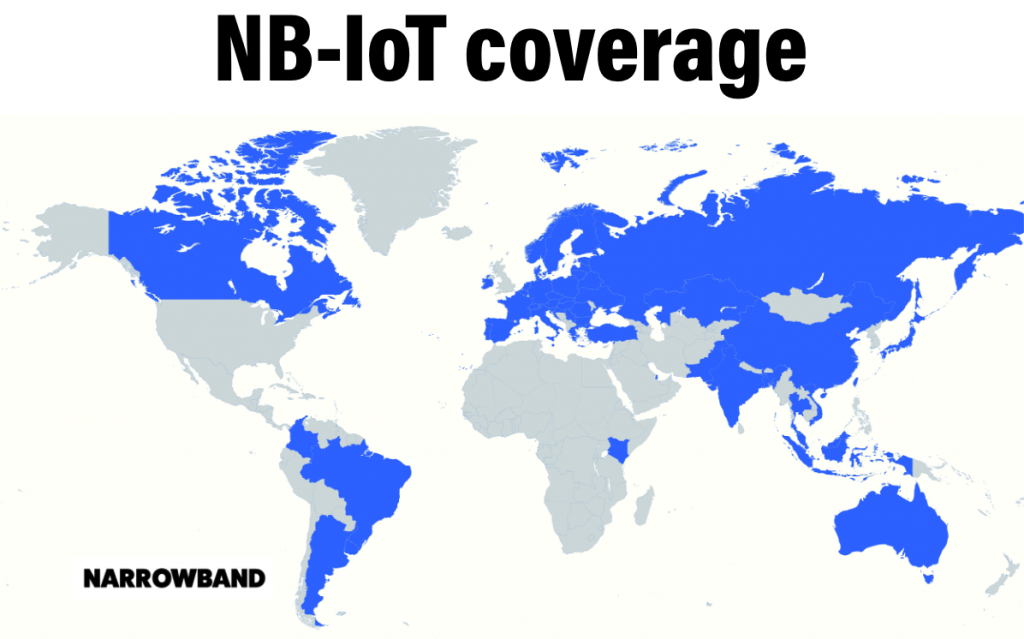 Furthermore, NB-IoT’s coverage is expanded by supporting low but stable uplink power, combined with optimized modulation and encoding for channels with high attenuation. This allows an NB-IoT base station to serve devices at the cell edge or in noisy environments while maintaining reliable communication. As a result, NB-IoT effectively meets the needs of deployment scenarios in hard-to-reach or inconvenient locations for maintenance, contributing to reduced operating costs and increased IoT system lifespan.
2. NB-IoT connection process
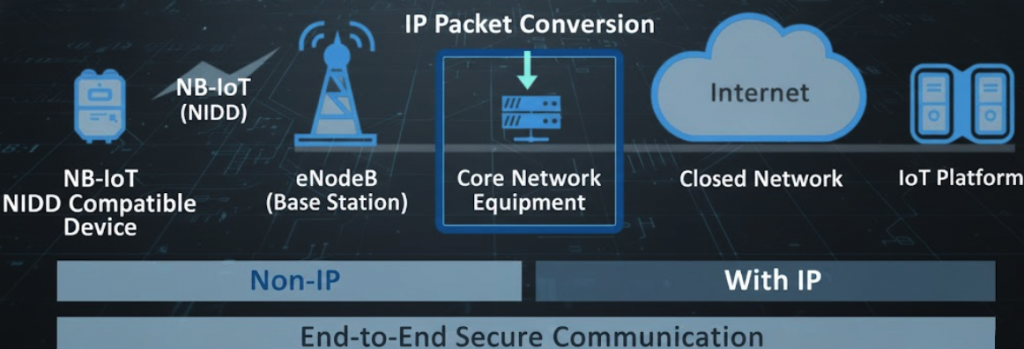
nb-iot structure
The Narrowband Internet of Things (NB-IoT) network architecture is a technical standard designed to connect a large number of smart devices with low power consumption and wide coverage. The core components of the system include:
- NB-IoT Devices: These devices are typically smart sensors or metering devices (such as water or electricity meters) that support NB-IoT technology.
- Electromagnetic Access Network (eNodeB): LTE base stations act as a wireless communication bridge between the devices and the core network.
- Evolved Packet Core (EPC): This is the central hub where data packets are processed, subscribers are managed, and packet switching services are performed.
- IoT Platform/Application Server: The endpoint where data is collected, analyzed, and services are provided to end users over the Internet.
NB-IoT systems have a distinct separation in how they handle communication protocols: First, non-IP transmission, meaning data from devices to the core network can be sent in raw form (NIDD – Non-IP Data Delivery) to optimize battery life and reduce device complexity. Second, with IP transmission, where data undergoes packet conversion (IP Packet Conversion) at the core network to ensure compatibility and transmission over standard internet environments. With this architecture, NB-IoT comprehensively ensures secure end-to-end communication from devices to application platforms; wide coverage with good penetration through walls and deep underground, suitable for urban or industrial environments; and large-scale connectivity leading to EPC core network systems designed to manage thousands of simultaneous connections across multiple sectors such as Smart Cities, Logistics, and Energy.
Based on the NB-IoT network architecture, we will delve into the details of the core technical components that enable this system to operate stably and securely. From wireless connectivity at the base station to data processing at the core network, each component plays a specialized role:
2.1. LTE Access Network (eNodeB & Uu Interface)
This is the first receiving layer in the model, responsible for establishing a physical connection with the device:
- eNodeB (LTE Base Station): These are improved base stations based on the traditional LTE standard, optimized for NB-IoT. They manage radio signal transmission and reception, coordinate resources, and ensure wide coverage for thousands of devices in an area.
- Uu Interface: This is the wireless connection interface between the device (UE) and the eNodeB. In NB-IoT, this interface is optimized to transmit small packets with extremely narrow bandwidth (Narrowband), minimizing interference and saving energy for the end device.
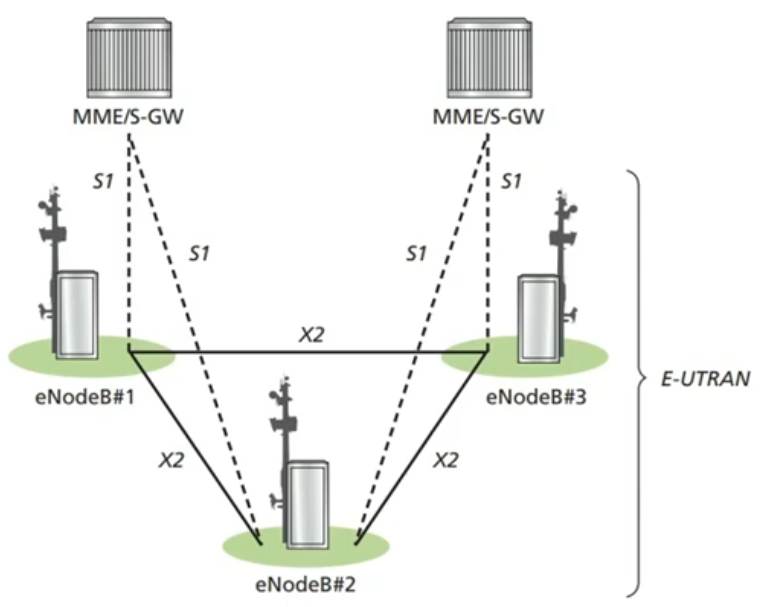
For example, this diagram shows: eNodeB (evolved NodeB), which are base stations in an LTE/NB-IoT network. In the diagram, the stations are numbered eNodeB#1, #2, #3, forming the radio access network; MME/S-GW: These are entities belonging to the Core Network. The MME manages control, while the S-GW manages user data flow. The interfaces include: Uu interface (not directly displayed by labels but implicitly) is the wireless connection between the device (UE) and the eNodeB stations; X2 interface: Solid lines directly connecting the eNodeB stations to each other. This interface is extremely important for handover and interference reduction coordination between stations; S1 interface: This is a dashed line connecting each eNodeB to the MME/S-GW. It is divided into two types:
- S1-MME: Used for control signals (Control Plane).
- S1-U: Used for user data (User Plane).
The entire cluster of eNodeBs and the X2 connections between them are collectively called E-UTRAN (Evolved Universal Terrestrial Radio Access Network). This is the “Access Network” that allows IoT devices to access the telecommunications network.
2.2. Core Network (MME, SGW, PGW)
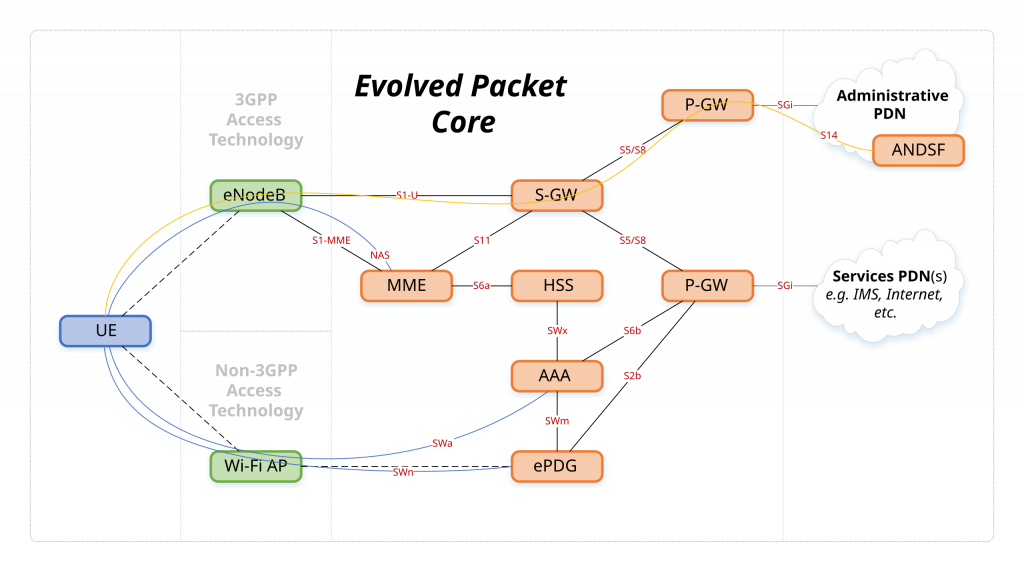
The EPC (Evolved Packet Core) network acts as the “brain” coordinating the entire data flow:
- MME (Mobility Management Entity): Responsible for managing mobility, authenticating devices when joining the network, and selecting appropriate service gateways for data transmission.
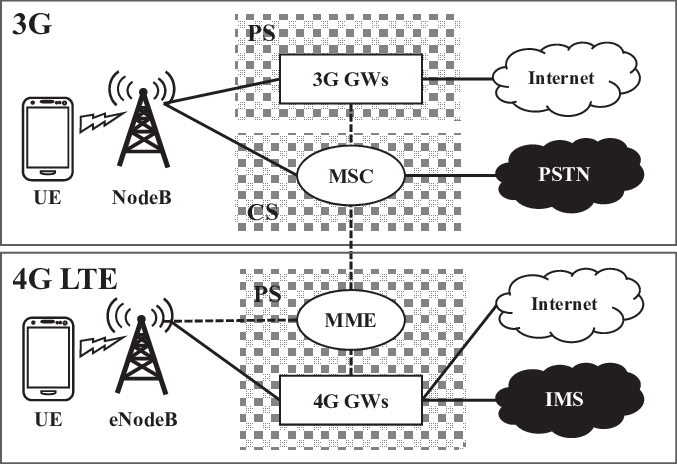
- S-GW (Serving Gateway): Acts as a data forwarding anchor point between the wireless access network and the core network. It ensures that packets are correctly routed when devices move or change their connection state.
- P-GW (PDN Gateway): Is the final connection point of the core network to external networks (Internet/ISP). P-GW performs tasks such as assigning IP addresses to devices (in the case of using IP) and enforcing Quality of Service (QoS) policies.
2.3. SCEF and Control Plane vs User Plane
These are the key components that help differentiate efficient data transmission methods in NB-IoT:
- SCEF (Service Capability Exposure Function): A specialized component for non-IP IoT devices. SCEF allows the core network to securely transmit small amounts of data through the control plane, eliminating the need for complex IP data session setups.
- Control Plane: Often used in NB-IoT to transmit even small application data (via NIDD). This is extremely efficient as it reduces redundant connection setup steps, maximizing battery life for sensors.
- User Plane: The traditional IP-based data transmission path (CIOT Data Plane). It is typically used for applications requiring larger data volumes or standard network protocols when connecting to IoT platforms.
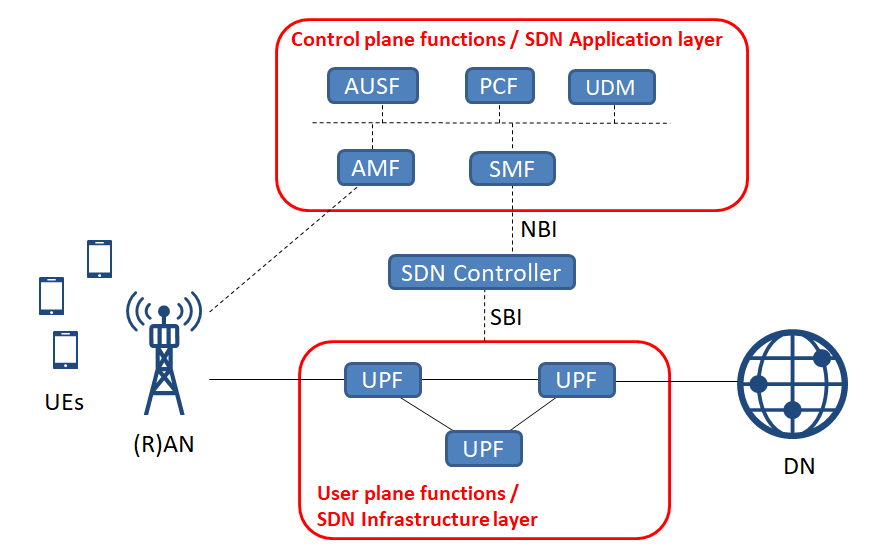
The coordination between these layers creates an end-to-end secure communication cycle, ensuring that data from even the simplest sensors can be securely transmitted to the centralized management platform.
3. NB-IoT Deployment Modes
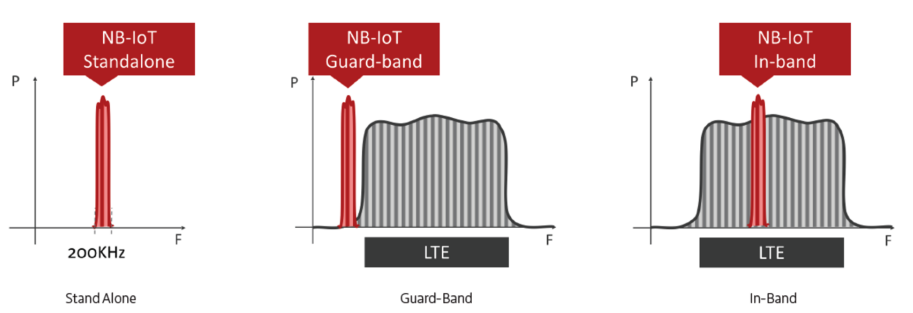
simulation nb-iot modes
The frequency spectrum of NB-IoT technology allows carriers to flexibly optimize their existing infrastructure: Standalone utilizes a separate frequency band, Guard-band exploits the guarded gaps between carriers, and In-band integrates directly into the existing LTE bandwidth. Each mode has different advantages and disadvantages; for easy comparison, the features are summarized in detail in the table below:
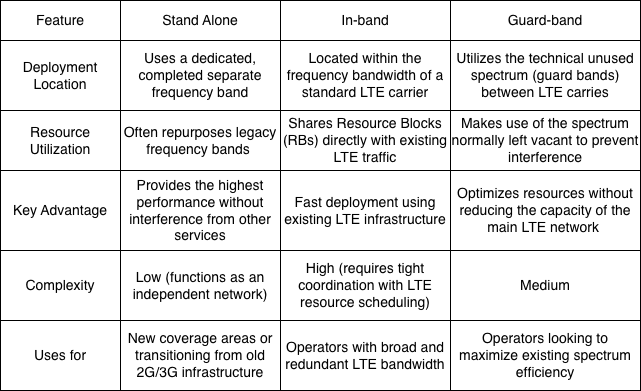
table of nb-iot’s feature
4. NB-IoT Protocol Stack & Key Technologies
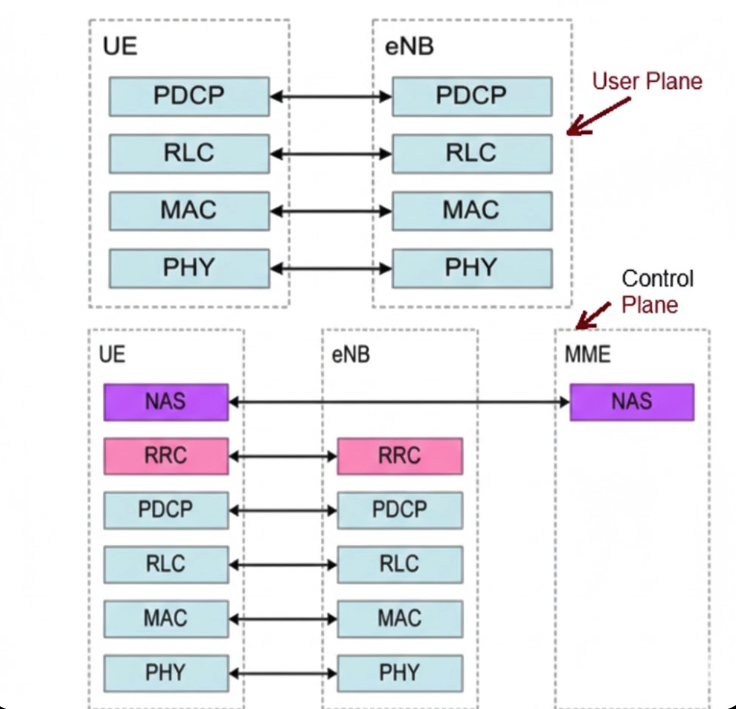
nb-iot protocol stack
This diagram illustrates how data and control commands are packaged and transmitted across different layers in an NB-IoT system to ensure synchronization between devices and network infrastructure. In the User Plane, the plane responsible for transmitting the actual user data between the device (UE) and the base station (eNB) is involved. Protocol layers include: PDCP (Packet Data Convergence Protocol) for header compression/decompression and data security; RLC (Radio Link Control) for data segmentation, reassembly, and ARQ error control; MAC (Medium Access Control) for scheduling and coordinating channel access; and PHY (Physical Layer) for transmitting physical signals over the radio space. On the other hand, in the Control Plane, this plane manages network connections, signaling, and control, involving three entities: the UE, the eNB, and the core network (MME). The additional layers include: NAS (Non-Access Stratum), the highest layer, which directly communicates between the UE and MME to manage mobility, authentication, and session establishment; RRC (Radio Resource Control), which manages the radio connection state between the UE and eNB (establishing, configuring, maintaining, and releasing connections); and the lower layers (PDCP, RLC, MAC, PHY), similar to the user plane but used to transmit control information instead of user data.
4.1. Physical Layer & Bandwidth
The physical layer of NB-IoT is specifically designed to optimize cost, energy, and extreme penetration capabilities. The system operates on a total bandwidth of 200 kHz, but actually utilizes 180 kHz, equivalent to a Resource Block in LTE. In terms of multiple access techniques, the downlink uses OFDMA with a subcarrier spacing of 15 kHz, while the uplink uses SC-FDMA supporting both single-tone (3.75 kHz or 15 kHz) and multi-tone (15 kHz) transmission.
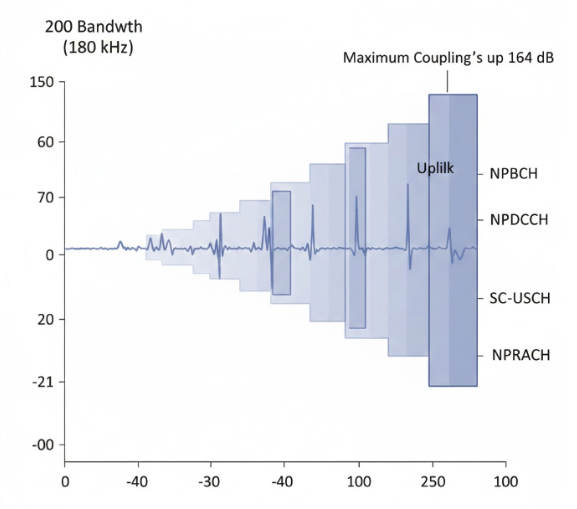
In particular, coverage is significantly improved thanks to a Maximum Coupling Loss (MCL) of up to 164 dB, combined with packet repetition techniques to ensure accurate transmission even in extremely weak signal conditions such as deep basements. This process is operated through a system of dedicated physical channels including NPBCH for system information transmission, NPDCCH for control and scheduling, NPDSCH and NPUSCH for user data transmission for downlink and uplink respectively, and NPRACH to support initial network access procedures.
4.2. Power Saving Mechanisms: PSM & eDRX
These are two key mechanisms that enable NB-IoT devices to extend battery life to over 10 years:
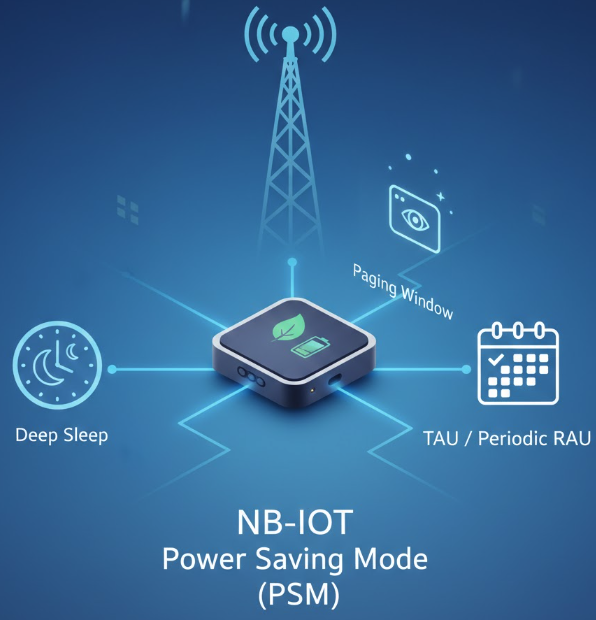
- PSM (Power Saving Mode): Allows the device to enter a deep sleep state while remaining registered with the network without needing to repeat complex connection procedures. In this mode, the device cannot be awakened by the network (Unreachable) until it actively sends data periodically.
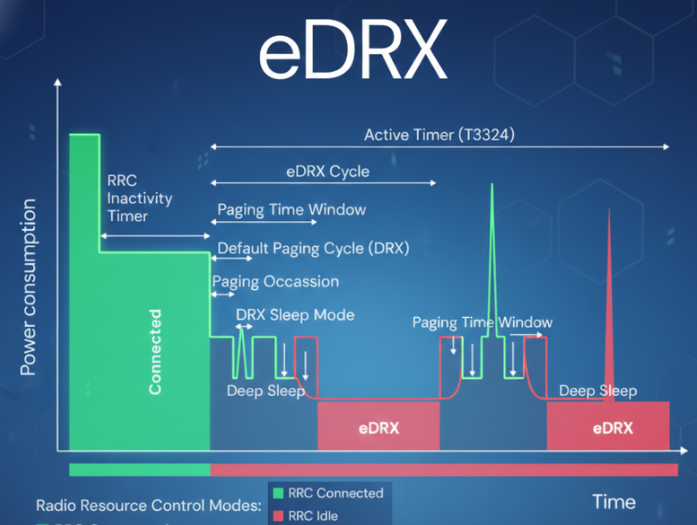
- eDRX (Extended Discontinuous Reception): Extends the signal checking cycle from the base station (Paging). Instead of continuous checking, the device only “wakes up” to listen for control signals during pre-configured intervals, significantly reducing power consumption compared to traditional DRX.
The core energy-saving mechanism of NB-IoT allows devices to operate for many years on a single battery. Below is a detailed description of the components in the diagram:
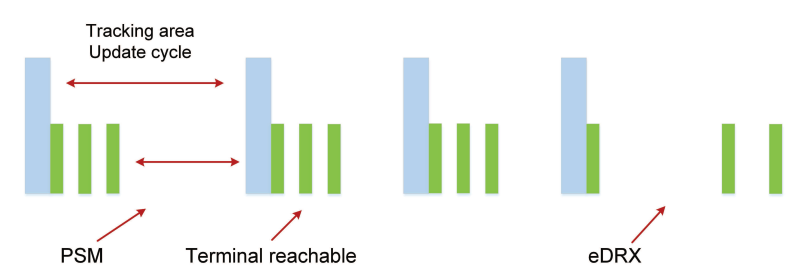
To optimize battery life for NB-IoT devices, the PSM and eDRX mechanisms play a key role in managing operating state and power consumption. PSM (Power Saving Mode) allows the device to enter a deep sleep state after completing the Tracking Area Update cycle, maximizing power savings because the device is completely unreachable from the network during this period. Meanwhile, eDRX (Extended Discontinuous Reception) extends the interval between device wake-ups for signal checking (paging), allowing the device to maintain a terminal reachable state more flexibly while significantly reducing power consumption compared to traditional check cycles. The seamless coordination between these two mechanisms helps the device balance data transmission and reception needs with the goal of extending battery life for decades.
4.3. Data Delivery: ID vs NIDD
NB-IoT offers two flexible data transmission methods depending on the application’s needs:
- IP Data Delivery (ID): Data is encapsulated using standard IP protocols (such as IPv4 or IPv6), suitable for applications requiring high compatibility with existing Internet platforms and the transmission of larger volumes of data.
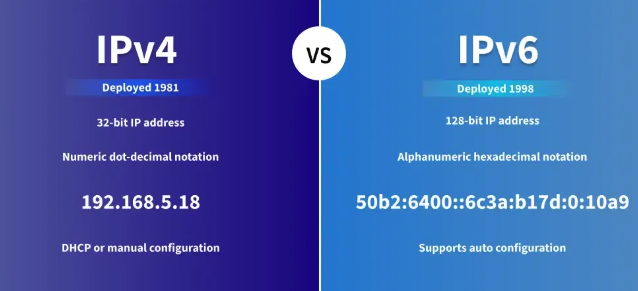
- Non-IP Data Delivery (NIDD): Allows the transmission of raw data without the IP packet header; data is transmitted through the Control Plane via the SCEF entity, reducing packet size and maximizing battery life for the device. This is optimized for sensors sending extremely small data (a few tens of bytes) and enhances security because the device does not have a public IP address, helping to avoid common cyber attacks.
 Unlike conventional IP data transmission (via SGW/PGW), this diagram accurately describes the NIDD route, enabling NB-IoT devices to maximize battery life and enhance security by not using public IP addresses. The presence of SCEF (Service Capability Exposure Function) is a core and unique component found only in the Non-IP data transmission route. It acts as a “gateway” to encapsulate raw data from the IoT device into control messages. Transmission via MME (Mobility Management Entity): In this diagram, data travels from eNB/gNB via the S1AP interface to the MME, then to the SCEF via the T6a interface. This route confirms that data is being transmitted on the Control Plane, a characteristic of the NIDD method for energy optimization. Connection to SCS/AS: After passing through the SCEF, data is transferred to the application platform (SCS/AS) via the T8 interface (based on HTTP). This is how devices without IP addresses can still communicate with servers on the Internet.
5. Advantages & Limitations
Advantages of NB-IoT
The main reasons for choosing NB-IoT connectivity, similar to LTE-M, include low power consumption, efficient spectrum utilization, and low deployment costs. These characteristics make NB-IoT particularly suitable for large-scale and long-term IoT systems.
Regarding power consumption, NB-IoT introduces two key power-saving mechanisms that give it an edge over older mobile networks like 2G, 3G, or 4G in IoT applications. Power Saving Mode (PSM) allows the device to enter a deep sleep state when not transmitting data, while maintaining its network subscription status. Unlike mobile phones – which need to maintain a constant connection to receive calls or messages – IoT devices typically transmit data only in defined cycles and require virtually no downlink. Therefore, they don’t need to send periodic Tracking Area Update (TAU) messages to inform the network of their location, significantly reducing power consumption. With PSM, the device can completely disconnect RF for extended periods without needing to repeat the attach procedure upon waking up.
For applications that still require network data reception capabilities, NB-IoT offers an Extended Discontinuous Reception (eDRX) mechanism. While conventional mobile devices must continuously check the radio channel in very short cycles, eDRX allows for extended paging listening periods of up to tens of minutes. This enables the device to still receive downlink messages such as configuration changes, firmware updates, or remote access, but with significantly lower power consumption compared to traditional DRX mechanisms.
NB-IoT is also designed to use spectrum efficiently. This technology operates on narrow bandwidths, reducing interference and enabling high device density deployment within the same cell. In addition to utilizing existing LTE bands, NB-IoT can also leverage guard bands – the portion of spectrum between LTE channels – to optimize radio resources. This approach allows carriers to expand the number of connected devices without significantly impacting the quality of service for traditional mobile users.
Indoor coverage, according to the Maximum Coupling Loss (MCL) index defined by 3GPP, NB-IoT achieves a theoretical MCL of up to 164 dB, higher than most other LPWAN technologies. This allows NB-IoT signals to penetrate thick building materials and operate stably in high-interference environments. However, to achieve this level of coverage, NB-IoT must use a packet repetition mechanism, leading to certain trade-offs in energy consumption.
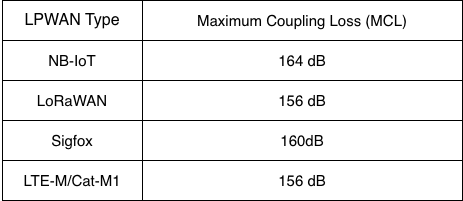
LIST OF MCL LPWAN
In terms of cost, NB-IoT uses modems with a simpler architecture compared to broadband LTE or 5G, thereby reducing hardware costs and total cost of ownership (TCO). NB-IoT modems have high global compatibility, facilitating multinational deployments. However, in some cases, NB-IoT devices need to support backup technologies such as 2G when NB-IoT coverage is not yet available, which can increase chipset complexity and cost.
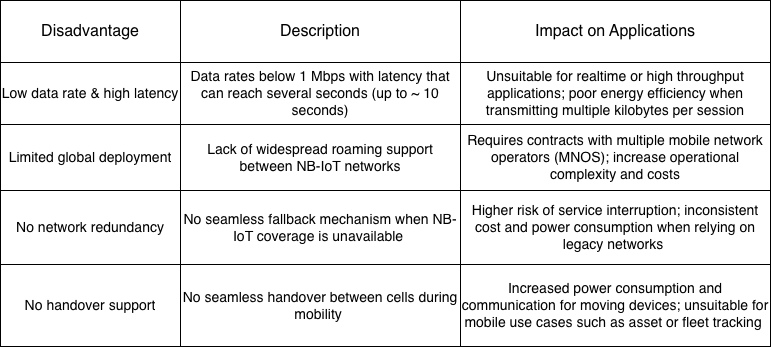
Limitations of NB-IoT
Despite its many advantages for static IoT applications, NB-IoT still has significant limitations, especially when compared to LTE-M, which need to be carefully considered before large-scale deployment.
6. Application of NB-IoT
NB-IoT is a LPWAN technology optimized for IoT scenarios with low data traffic, low transmission frequency, and long battery life requirements. By trading off speed, latency, and mobility, NB-IoT achieves deep coverage, high stability, and minimal power consumption. However, limitations in throughput, roaming, redundancy, and handover make NB-IoT unsuitable for real-time, mobile, or global deployments. Therefore, the selection of NB-IoT should be based on specific application characteristics, rather than viewing it as a universal IoT solution.
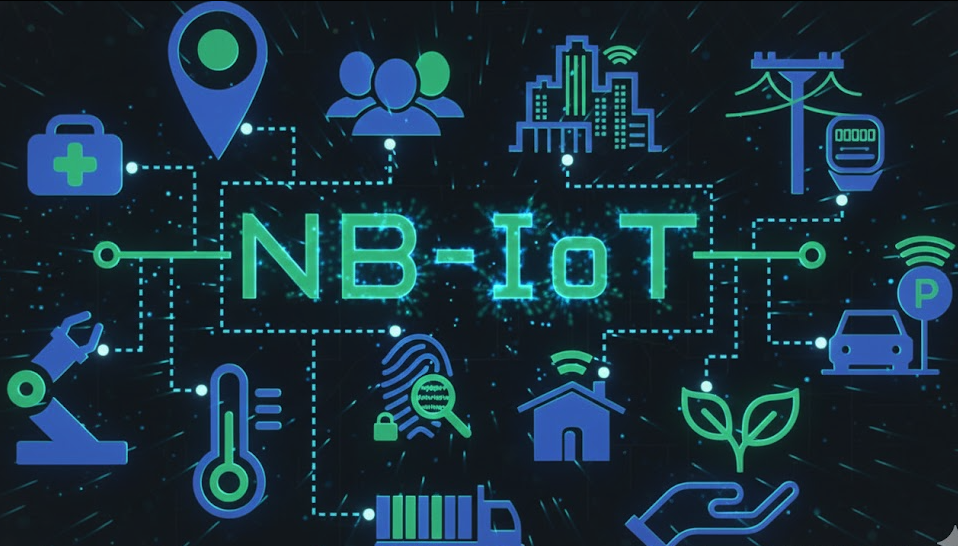
Thanks to its stable operation and energy efficiency, NB-IoT is particularly well-suited for large-scale, static IoT systems where each device transmits only a small amount of data over long cycles. Typical applications include smart metering (electricity, water, gas), environmental monitoring (air quality, water level, temperature), smart urban infrastructure (streetlights, parking lots), smart agriculture, and indoor or underground fixed asset tracking systems. In these scenarios, NB-IoT offers optimal efficiency in terms of operating costs, battery life, and long-term reliability.
7. Comparison between NB-IoT & LTE-M
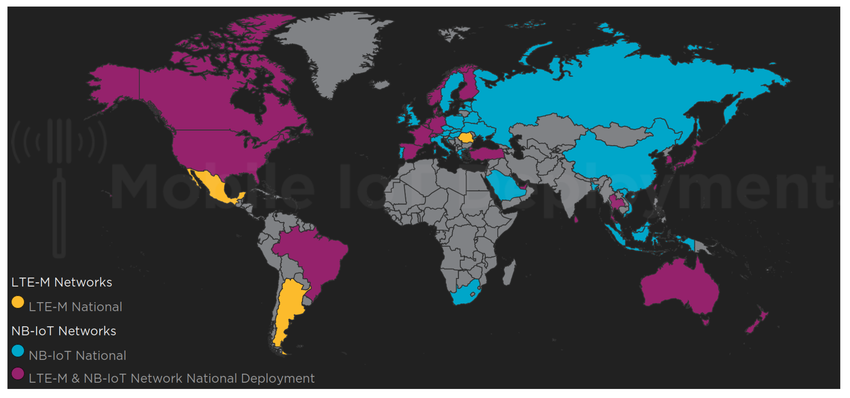
NB-IoT and LTE-M are two LPWAN technologies developed by 3GPP to support large-scale IoT connectivity over mobile network infrastructure. In IoT systems, coverage plays a crucial role, especially for devices deployed indoors, underground, or at the cell edge.
NB-IoT is optimized for deep coverage thanks to its narrow 180 kHz bandwidth and transmission loop mechanism, achieving a Maximum Coupling Loss (MCL) of approximately 164 dB, suitable for static devices in environments with high signal loss. Meanwhile, LTE-M provides wider coverage with better mobile support, having an MCL of approximately 156 dB, suitable for both static and mobile scenarios.
Beyond coverage, the choice between NB-IoT and LTE-M also depends on factors such as speed and latency, mobility, power consumption, device cost, and roaming capabilities. These differences are summarized and compared in detail in following the table:
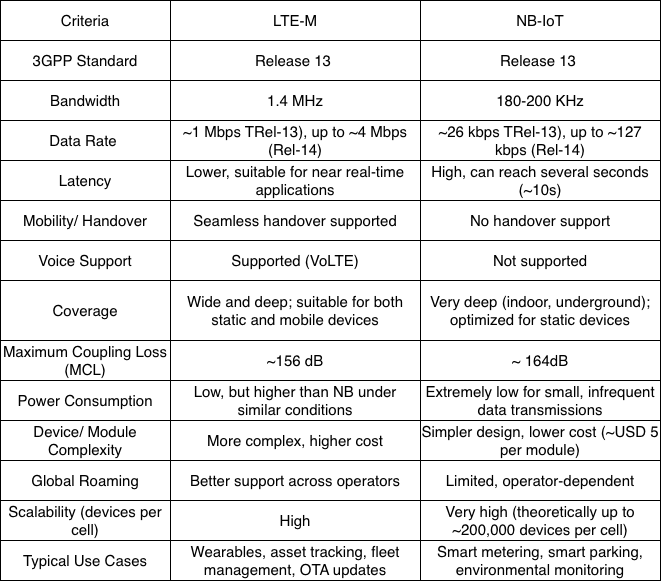
THE COMPARISON BETWEEN LTE-M VS NB-IOT
LTE-M is well suited for IoT applications that require mobility, lower latency, higher data rates, OTA firmware updates, voice support, and global roaming. NB-IoT is optimized for static IoT devices that transmit very small amounts of data, infrequently, and require deep coverage and multi-year battery life. Fundamentally, these two technologies do not directly compete, but rather complement each other within the Mobile IoT ecosystem.