1. Introduction to Bluetooth Low Energy Data Transfer Speed
2. Speed in PHY modes
3. BLE Data Transfer Speed Demo Using an IoT Project
4. Conclusion and Futute Improvements for BLE Data Transfer
1. Introduction to Bluetooth Low Energy Data Transfer Speed
Welcome to Industrial Embedded Solutions – where we deliver modern, reliable, and optimized industrial embedded solutions for real-world challenges in manufacturing, IoT, and automation. With a team of experienced engineers, we focus on transforming complex technologies into efficient, easy-to-deploy, and scalable solutions.
In this content, we introduce the topic of BLE speed (Bluetooth Low Energy) – a critical factor when designing low-power wireless communication systems. You will explore the factors that affect BLE data throughput, the practical limitations compared to theoretical values, and effective ways to optimize configurations to achieve the best performance for industrial embedded applications.
In Bluetooth Low Energy (BLE), the term ”speed” refers to the normal data rate at the physicals (PHY) layer, representing the number of bits that can be transmitted over the wireless channel per second. According to the BLE 5.x specification, common PHY modes include 1M PHY with a data rate of 1Mbps anh 2M PHY with a data rate of 2 Mbps. These values are theoretical anh do not directly represent the mount of useful data received by the application, as protocol overhead from higher layers such as the Link Layer and ATT/GATT is still present. Therefore, BLE speed is primarily used to describe the transmission capability of the standard and hardware, while actual data transmission performance should be evaluated using throughput.
2. Bluetooth Low Energy Speed Across PHY Modes
BLE (Bluetooth Low Energy) speeds typically reach a maximum of 1-2 Mbps (Megabits per second) depending on the version, but actual throughput is lower (around 305 kbps) due to optimization for energy saving, sending short data streams, and frequent pauses between transmissions, unlike Bluetooth Classic (1-3 Mbps) used for continuous transmission such as audio. BLE versions 5.0 and above can achieve 2 Mbps (high speed) or decrease to 125/500 kbps (long range), but the main purpose remains low power consumption. BLE: Lower speed, optimized for energy saving, suitable for sensors, wearable devices (IoT), and small data transmission.
For 1M BLE, the speed is 1 Megabit/second (Mbps). This is the most basic and common PHY physical layer, supported by all BLE devices, operating at 1 Megasymbol/second (Msym/s). Although the theoretical speed is 1 Mbps, actual throughput is often lower (around 305 kbps) due to factors such as encoding and overhead, but it offers a good balance between power saving and operating range for everyday applications. This is the standard and backward-compatible PHY mode; all Bluetooth LE devices must support it. It’s suitable for transmitting small data such as sensor status and notifications, as it optimizes power. When two BLE devices connect, they start in 1M PHY mode, then can switch to faster modes if both support it (e.g., LE 2M PHY).
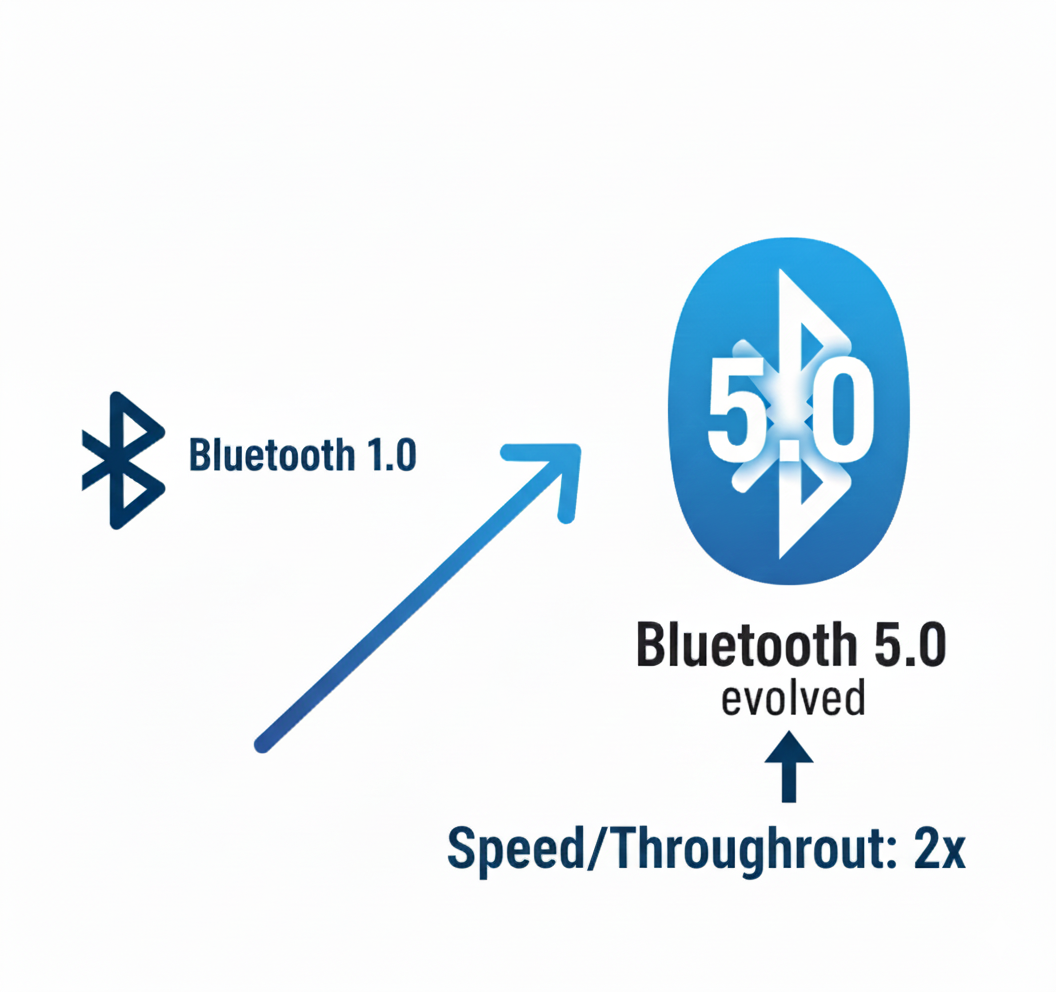
For 2M BLE, the speed is 2 Megabits per second (2 Mbps), introduced in Bluetooth 5.0, doubling the speed of 1M PHY BLE, allowing for faster data transmission or reduced transmission times to save energy, but comes with a shorter range due to the higher speed. 2Mbps BLE is designed to increase data transmission speed on the PHY (Physical Layer). This doubles the amount of bits transmitted in the same amount of time, reducing transmission time and thus reducing energy consumption for the same amount of data. However, the system has to compromise on speed, potentially increasing the bit error rate and resulting in a narrower connection range (approximately 80% compared to 1Mbps PHY). 2Mbps BLE is suitable for IoT applications requiring fast but not excessively large data transmission, such as temperature and humidity sensors. Comparison with other BLE speeds 1Mbps BLE PHY 1 Mbps (base speed, wider range):
• Coded PHY (S=2): 500 Kbps (the speed is lower but the scale is farther).
• Coded PHY (S=8): 125 Kbps (the worst speed, the furthest scale).
The speed of BLE Coded (Bluetooth LE Coded) in Bluetooth 5.x depends on the encoding mode, offering two main speeds to prioritize range over high speed: 125 kbps (S=8) and 500 kbps (S=2), using a Forward Encoding Scheme (FEC) to increase stability and range (up to 1000m under ideal conditions), much lower than the 1 Mbps or 2 Mbps speeds of uncoded PHYs. When connecting devices over very long distances (e.g., IoT devices in smart homes, industrial sensors), using BLE Coded becomes optimal, where stability and coverage are more important than fast data transmission speed. In short, BLE Coded is a trade-off in Bluetooth 5.0+ for speed, allowing for more robust connections over long distances.
From this, we can summarize the speed, throughput, and other factors of the different BLE variants as follows:
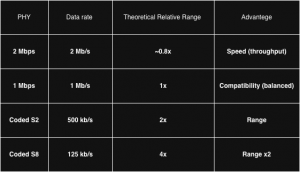
Table of compare between the variants of BLE
The symbol rate in BLE defines the number of modulation symbols transmitted per second at the physical layer and is expressed in symbols per second (sym/s). In BLE 1M and 2M PHY modes, Gaussian Frequency Shift Keying (GFSK) modulation is employed, where each symbol represents one bit of information. As a result, the symbol rate is numerically equal to the nominal PHY date rate. Specifically, the 1M PHY operates at a symbol rate of 1 Msym/s, while the 2M PHY operates 2Msym/s. Increasing the symbol rate directly increases the nominal transmission speed; however, it also reduces receiver sensitivity and shortens the effective communication range, making higher symbol rates more susceptible to noise and interference.
3. BLE Data Transfer Speed Demo Using an IoT Project
To understand BLE more clearly, we started to create a demo using Bluetooth Low Energy in IoT to record with IoS standard and Android standard. The demo system is built around the Nordic Semi- conductor nRF52840, a BLE 5.0 – capable SoC supporting 1M and 2M PHY, Data Length Extension (DLE) and extended MTU sizes. The nRF52840 operates as a BLE peripheral, while smartphones running iOS and Android act as BLE central devices. On the embedded side, the firmware is developed using the Nordic SDK or Zephyr RTOS BLE stack, which allows fine-grained control over PHY mode, connection parameters, and GATT behavior. On the mobile side, the demo application uses CoreBluetooth on iOS and the Android BLE API on Android to receive data from the peripheral.
The experimental results show a clear performance difference between iOS and Android under identical peripheral configurations. When connected to Android devices, the BLE link achieves significantly higher throughput, approaching the expected performance for a 2M PHY configuration. In contrast, iOS devices exhibit lower throughput despite successfully negotiating the same MTU size and PHY mode. This difference is primarily attributed to platform-level restrictions in iOS, including limited control over connection interval, stricter notification pacing, and conservative scheduling policies designed to optimize power consumption.
Although both of platforms report the same nominal BLE speed at the PHY level, the effective data rate observed on iOS is substantially lower. This demonstrates that BLE speed alone does not determine real world data transfer performance and highlights the importance of throughput based evaluation.
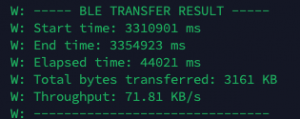
Carry out a survey of throughput on Android
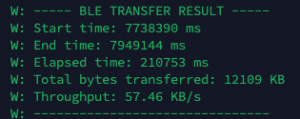
Carry out a survey of throughput on IoS
The results confirm that BLE performance is not solely determined by the peripheral hardware or the BLE specification, but also by the operating system and BLE stack implementation of the central device. Android provides greater flexibility in controlling BLE connection parameters, allowing higher data rates to be achieved. In contrast, iOS abstracts the Link layer and enforces conservative limits to ensure energy efficiency and system stability. These design choices make iOS less suitable for high throughput BLE applications but beneficial for long battery life.
4. Conclusion and Future Improvements for BLE Data Transfer
In conclusion, BLE speed is influenced by many factors beyond the theoretical specifications of Bluetooth Low Energy, including PHY selection, connection interval, packet size, protocol overhead, and the processing capability of the embedded system. While BLE is not designed to compete with high-throughput wireless technologies, it offers an excellent balance between data rate, power consumption, and reliability.
By understanding these limitations and carefully tuning parameters such as MTU size, Data Length Extension, and PHY mode, developers can significantly improve real-world throughput. Ultimately, optimizing BLE speed is not about achieving the maximum possible data rate, but about meeting application requirements efficiently while maintaining low power consumption and stable communication—key priorities in industrial embedded and IoT systems.